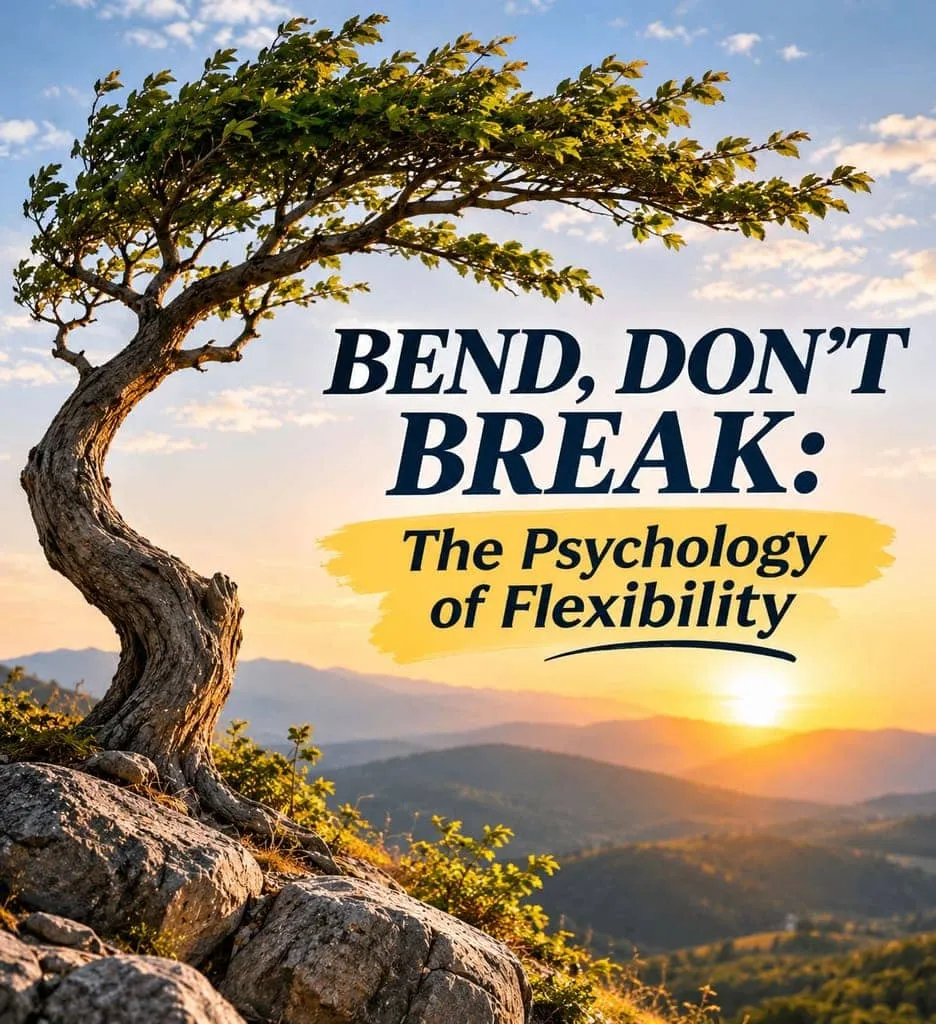
Bend, Don't Break: The Psychology of Flexibility
We often admire people who stand firm—those who “stick to their guns” and refuse to be swayed. But when does strength become stiffness? In both body and mind, rigidity might look like control, yet it can quietly hold us back.
Psychologists describe flexibility as one of the key ingredients of mental health. It is the ability to adapt when life throws us a curveball—to bend without breaking. In contrast, cognitive rigidity means getting stuck in a single way of thinking, unable to see other perspectives. Dr. Steven Hayes, founder of Acceptance and Commitment Therapy (ACT), calls this “psychological inflexibility,” and research shows it is closely linked to anxiety, depression, and even burnout.
Our brains love routine—it saves energy. But when we cling too tightly to habits or beliefs, we risk turning life into a loop. Neuroscientists have found that people who struggle to switch between tasks or viewpoints show less activity in a brain area called the prefrontal cortex, responsible for flexible thinking and problem-solving. In short, mental stiffness makes it harder to “go with the flow.”
In daily life, rigidity often hides behind perfectionism or control. We plan every detail, insist things be done “our way,” and resist change like a stubborn mule. But the world doesn’t play by our rules. A flexible person can roll with the punches—they may not like change, but they learn to dance with it. As the saying goes, “It’s not the strongest or the smartest who survive, but those who can adapt.”
Even in relationships, flexibility acts like oil in the machinery. When partners or colleagues refuse to budge, tension builds up like a tight muscle. But when both sides are willing to bend a little, things flow smoothly. Therapists often say that couples don’t fall apart because of big differences, but because neither partner can “meet halfway.”
Interestingly, physical flexibility and mental flexibility are connected. Studies show that people who practice yoga, stretching, or dance often report greater emotional balance and adaptability. Movement seems to teach the body and brain the same lesson—that balance comes from fluidity, not rigidity.
Of course, being flexible doesn’t mean having no backbone. There’s a fine line between open-mindedness and indecision. True flexibility means knowing when to stand firm and when to let go. It’s being grounded yet adaptable—like a tree that sways in the wind but keeps its roots deep.
In a world that changes faster than ever, flexibility may be the ultimate strength. The most successful people—and happiest, too—are often those who can adjust their sails when the wind shifts. As the old proverb goes, “Blessed are the flexible, for they shall not be bent out of shape.”
Vocabulary from this article
rigidity
noun/rɪˈdʒɪdəti/
Being stiff and unwilling to change your ideas or behaviour.
adapt
verb/əˈdæpt/
To change the way you think or act so you can deal with a new situation.
curveball
noun/ˈkɜːvbɔːl/
An unexpected problem or change that is hard to deal with.
cognitive
adjective/ˈkɒɡnətɪv/
Connected with thinking, understanding, and learning.
cling
verb/klɪŋ/
To hold on tightly to something, or refuse to let a habit or belief go.
perfectionism
noun/pəˈfekʃənɪzəm/
The habit of wanting everything to be perfect, even when that causes stress.
budge
verb/bʌdʒ/
To move a little, or to change your opinion slightly.
adaptable
adjective/əˈdæptəbl/
Able to change easily when a situation changes.
grounded
adjective/ˈɡraʊndɪd/
Calm and sensible, with a clear sense of what matters.
indecision
noun/ˌɪndɪˈsɪʒn/
The state of being unable to decide what to do.
Which word matches this meaning?
Reading settings
Tone
Font
Margins