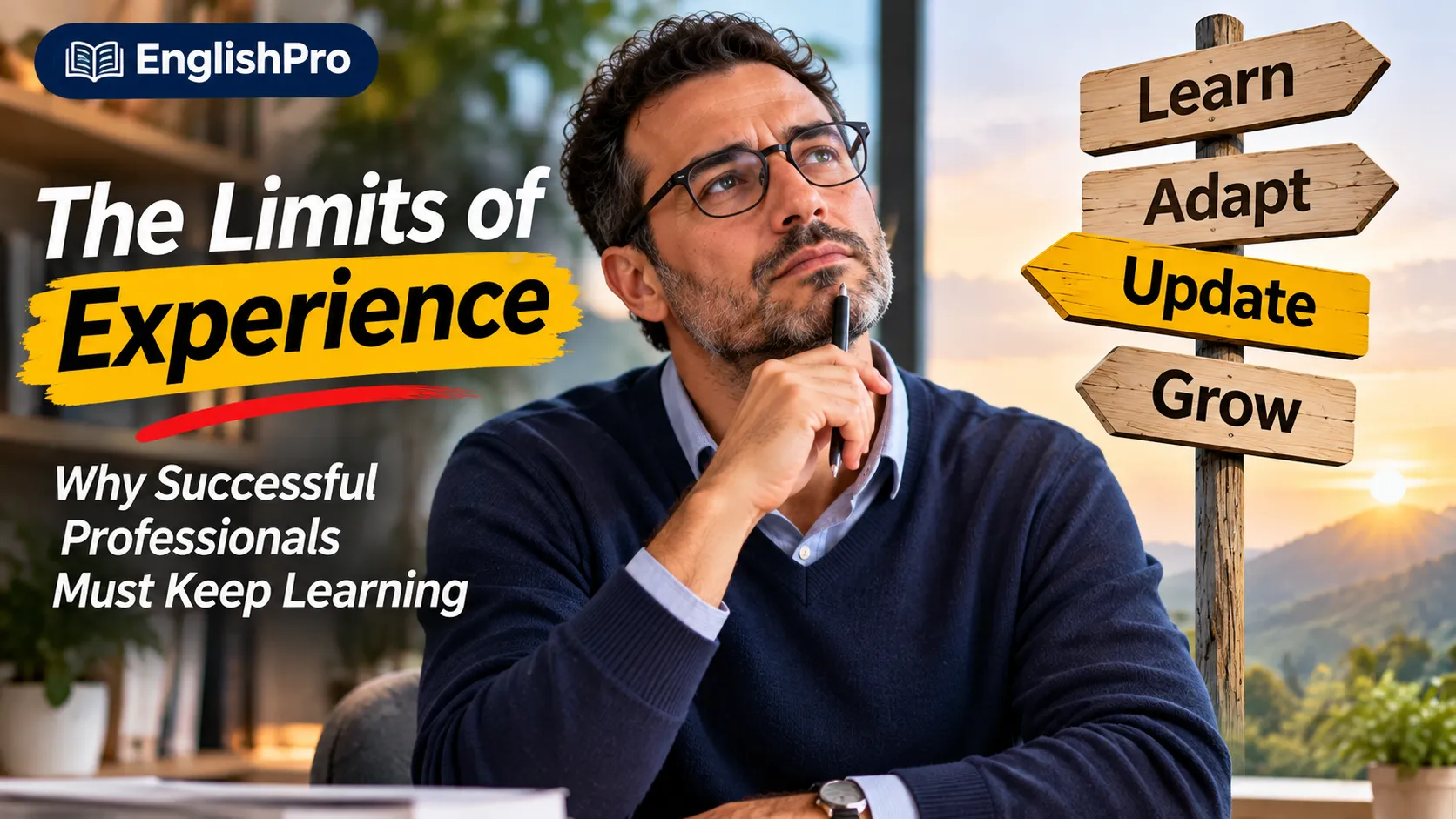
The Limits of Experience: Why Successful Professionals Must Keep Learning
Imagine someone who has worked in the same industry for fifteen years. They know their job inside out. They understand the procedures, recognise common problems and can deal with difficult situations without much hesitation. Their colleagues often turn to them for advice.
Experience has made them confident and efficient. But there may be a problem. They have become so familiar with the way things work that they no longer notice when things begin to change.
A new employee suggests a different approach. The experienced professional dismisses it immediately. A new piece of technology becomes available, but they see no reason to learn how to use it. A procedure that worked perfectly well ten years ago is still being followed, even though better alternatives now exist.
What happened?
The very experience that once made this person successful may now be preventing them from moving forward.
When experience becomes a limitation
Experience is valuable. It allows us to recognise patterns, make informed decisions and avoid repeating mistakes. However, it can also encourage us to rely too heavily on familiar ways of thinking.
When we perform the same tasks repeatedly, we gradually stop thinking about every step. We operate on autopilot. This is useful because it saves time and mental energy. We don’t need to reconsider every decision or challenge every procedure.
The difficulty begins when automatic behaviour replaces careful thinking.
Consider a manager who has used the same method to organise a team for many years. The method has worked well, so the manager sees no reason to change it. However, the team has grown, employees now work remotely, and the company’s priorities have changed.
The manager continues using the old system because it feels familiar. Instead of examining whether it still works, they assume that what worked in the past will continue to work in the future.
This is where experience can turn into complacency: a comfortable feeling that there is nothing more to learn or improve.
Being experienced doesn’t mean being right about everything. In fact, the more familiar we become with a particular way of working, the harder it can be to recognise its limitations.
The danger of knowing too much
One of the surprising things about expertise is that it can make us less curious.
When we are new to a job, we ask questions constantly. Why do we do things this way? Is there a better method? What happens if we try something different?
As we gain experience, however, we develop routines and beliefs about how things should be done. These beliefs become assumptions, and we may stop examining them.
For example, an experienced salesperson might believe that customers always prefer face-to-face meetings. This belief may have been reasonable for years. But customer expectations change. Some now prefer online appointments because they are quicker and more convenient.
If the salesperson refuses to reconsider their approach, they may gradually lose opportunities to competitors who are more willing to adapt.
The problem isn’t necessarily a lack of knowledge. It is the belief that existing knowledge is enough.
Experts can also develop a blind spot. Because they understand their own work so well, they may fail to notice how confusing their explanations are to beginners. They might use technical language without realising that others don’t understand it, or overlook problems that seem obvious to someone with less experience.
Sometimes, being an expert makes it difficult to see things from a beginner’s perspective.
Staying relevant in a changing world
Professional knowledge has a limited shelf life. Industries develop, technology changes and customer expectations evolve. What made someone successful five years ago may not be enough today.
This doesn’t mean that everything we know becomes outdated. Many professional skills remain valuable for decades. Good communication, sound judgement and the ability to solve problems, for example, are unlikely to lose their importance.
However, the way we apply these skills may need to change.
A teacher who has spent years using traditional classroom methods may discover that digital tools can make certain activities more effective. An accountant may need to learn new software. A manager may have to rethink how they lead a team whose members work from different locations.
In each case, experience provides a useful foundation, but it cannot replace continuous learning.
This is why adaptability matters so much. It is not simply about accepting every new idea or following every trend. It means recognising when circumstances have changed and being willing to adjust your approach.
The most valuable professionals are not necessarily those who know the most. They are often those who know how to update their knowledge and apply it in new situations.
Learning to become a beginner again
So how can experienced professionals avoid becoming too comfortable with what they already know?
One useful habit is to regularly question your own methods. Instead of automatically following established procedures, occasionally ask yourself whether they still serve their purpose. Could something be done more efficiently? Are there new tools worth exploring? What would you do differently if you were starting this job today?
Another approach is to seek feedback, particularly from people who have different levels of experience. A junior colleague may notice a problem that someone with years of experience has stopped seeing. A customer may offer a perspective that challenges your understanding of what people actually need.
It is also worth making time to learn outside your immediate area of expertise. Reading about other industries, attending professional events or simply talking to people in different roles can introduce ideas you would not normally encounter.
Most importantly, become comfortable with saying, “I don’t know.”
For some professionals, this can be difficult. Experience often comes with expectations. People look to them for answers, and admitting uncertainty may feel uncomfortable.
But recognising what you don’t know is not a sign of weakness. It is the beginning of learning something new.
The advantage of remaining curious
There is a difference between having experience and being limited by it.
Experience should give us confidence, but it should not make us resistant to new ideas. It should help us make better decisions, not prevent us from reconsidering old ones.
Think about the people you most admire professionally. Many of them are probably not the ones who constantly remind others how much they know. They are the ones who remain interested, ask thoughtful questions and are willing to change their minds when presented with better information.
They understand that expertise is not a final destination. It is something that develops over time.
Perhaps the real measure of professional experience is not how many years you have spent doing something, but how much you have continued to learn during those years.
After all, the moment we believe we have nothing left to learn may be the moment we begin to fall behind.
Vocabulary from this article
autopilot
noun/ˈɔːtəʊˌpaɪlət/
A way of doing things automatically, without thinking carefully about each action.
complacency
noun/kəmˈpleɪsənsi/
A feeling of satisfaction that makes you stop trying to improve.
assumptions
noun/əˈsʌmpʃənz/
Ideas you accept as true without checking whether they are correct.
blind spot
noun/ˈblaɪnd spɒt/
Something important you fail to notice or understand about yourself or a situation.
outdated
adjective/ˌaʊtˈdeɪtɪd/
No longer useful or suitable because circumstances have changed.
seek feedback
verb phrase/siːk ˈfiːdbæk/
To ask other people for their opinions about your work or behaviour.
adaptability
noun/əˌdæptəˈbɪləti/
The ability to change your approach when circumstances change.
question
verb/ˈkwestʃən/
To examine whether something is correct, reasonable or necessary.
Which word matches this meaning?
Reading settings
Tone
Font
Margins